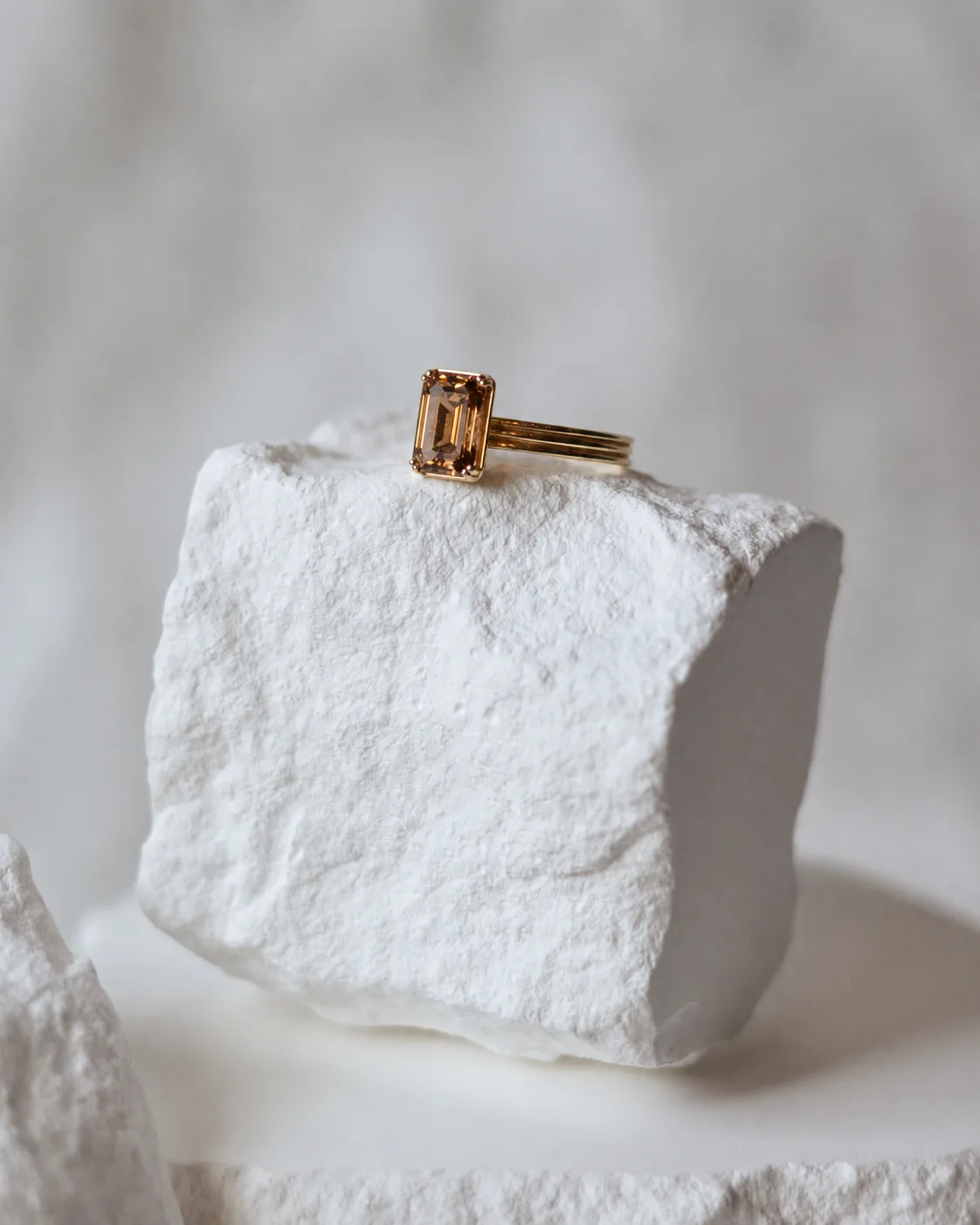
A champagne diamond is a brown diamond with the same carbon crystal structure, the same Mohs 10 hardness, and the same grading criteria as any other diamond, but with a warm, honey-to-amber hue. The name is marketing language, not gemological language. It dates to the 1980s, when Rio Tinto began rebranding the brown output of Australia’s Argyle mine as champagne, cognac, and chocolate. The rebranding worked. A stone once considered the least desirable category of gemstone became one of the most searched-for fancy colors on the market, and the name stuck.
The color is real, the stone is real, and the price difference relative to colorless diamonds is substantial. What the “champagne” label does is describe something genuine: a warm, shifting character that reads pale gold in overhead light and deepens to amber in sunlight or candlelight. That quality was always there. The naming just finally gave it language.
The timing matters too. Warm metal tones like yellow and rose gold have dominated fine jewelry for most of the past decade, and champagne diamonds are one of the few stones that genuinely belong in that aesthetic rather than simply sitting in it. The shift away from identically cut white solitaires has created space for stones with character and visual distinctiveness. A champagne diamond in a cushion cut and yellow gold setting doesn’t look like anyone else’s engagement ring. That specificity has value, and buyers are recognizing it.
Key Takeaways
- Champagne diamonds are brown diamonds. The name describes the color: a warm, honey-to-amber hue. “Cognac” refers to the deeper, more saturated end of the same family.
- The C1–C7 scale was developed by Argyle mine to standardize brown diamond grades from pale straw (C1) to deep cognac (C7). GIA uses separate “Fancy Color” descriptors for the same stones.
- Brown is the most common fancy diamond color, which is why champagne diamonds cost significantly less than colorless stones — typically 40–70% less for comparable carat, cut, and clarity.
- The color comes from structural distortions in the crystal lattice, not from trace elements like nitrogen. This makes the formation mechanism distinct from yellow or blue diamonds.
- Yellow and rose gold are the strongest metal pairings. Both metals share the warm tone of the stone, creating a cohesive look rather than contrast.
- Lab-grown champagne diamonds exist and carry the same chemical and optical properties as natural ones, though they are less common on the market than colorless lab-grown stones.
What Is a Champagne Diamond?
Yes. A champagne diamond is a genuine diamond with a warm brown to yellow-brown hue. It is not a simulant, not a treated stone (unless specifically noted), and not a lesser material. The color is intrinsic to the crystal. Same stone, different hue.
A champagne diamond is a natural or lab-grown diamond that displays a warm brown hue, ranging from pale straw to rich amber. GIA doesn’t use “champagne” as a grade. What GIA recognizes is that these stones fall within the “Fancy Color” category, where hue, saturation, and tone together determine grade and value, rather than the D-to-Z colorless scale used for white diamonds.
What the “champagne” name captures reasonably well is the visual quality of the lighter stones in this range: pale gold, warm straw, honey-tinted. Deeper brown stones are typically called cognac, and the darkest can be described as chocolate. These names all describe points on the same brown diamond spectrum.
Brown diamonds spent decades overlooked not because of any flaw in the stone, but because the industry had no vocabulary for what made them appealing. Understanding that you’re looking at a fancy color diamond on its own grading scale, with its own pricing logic, is what makes the decision clearer.
Why Are Champagne Diamonds Brown?
Most diamond colors result from trace elements substituting for carbon atoms in the crystal structure. Yellow diamonds form when nitrogen atoms are present in clusters within the lattice. Blue diamonds contain trace boron. But brown is different.
The dominant cause of brown color in diamonds is plastic deformation, the physical stress on the crystal during formation that creates microscopic defects along what are called slip planes. These structural irregularities selectively absorb certain wavelengths of light, producing the characteristic warm brown absorption signature.
This mechanism doesn’t affect how the diamond performs visually or how it wears. The structural distortions are microscopic: not visible to the eye, not detectable without specialized equipment, and not meaningful to everyday wear. Understanding the cause is useful for context, not for evaluation.
It also explains why brown diamonds are common. Plastic deformation is a typical outcome of diamonds forming under variable geological pressure, whereas the precise trace element concentrations required for blue, green, or red diamonds occur rarely.
The C1–C7 Color Scale
The C1–C7 scale was developed by Argyle mine to standardize descriptions of their brown diamond production. It remains the most widely used shorthand for champagne and brown diamonds in the trade, even though GIA doesn’t formally apply it in reports. Many dealers reference C grades when selling fancy brown stones because the scale is practical and well understood.

C1–C2 — Light Champagne
The palest range. These stones display a faint, almost neutral warmth, leaning more toward golden straw than brown. In certain lighting, they can read as near-colorless with a slight warm cast. Think pale winter sunlight through honey: barely there, but unmistakably warm. C1–C2 stones are the most common, the most affordable, and the most likely to look subtly warm rather than distinctly fancy-colored to an untrained eye. Good choice if you want warmth without a strong color statement.
C3–C4 — Champagne
The middle of the range, and what most people mean when they say “champagne diamond.” C3–C4 stones have a clear warm brown tone visible in most lighting. The color is complex rather than flat. It shifts between conditions, showing cooler gold under artificial light and deepening to rich amber in sunlight or candlelight. This is where the name makes the most visual sense, and where demand is highest within the category.
C5–C6 — Dark Champagne
Deeper, richer, with an amber-to-brown quality that reads as clearly intentional. In warm or natural light, C5–C6 stones have a richness like polished wood or aged cognac: deep, warm, and wholly committed to the color. These stones are sometimes marketed as cognac at the lighter end of this band. The warmth is pronounced, the stone reads as a genuine fancy color, and pairing potential with yellow and rose gold is at its highest here. Inclusions are typically even less visible at this depth of color.
C7 — Cognac
The deepest end of the scale. True cognac diamonds have a rich, warm orange-brown that reads as genuinely luxurious under good lighting. In direct sunlight, the color can tip toward copper, burnished and unmistakably intentional. GIA would describe these as Fancy Dark Brown or Fancy Deep Brownish Orange. C7 stones are the rarest in this family.
- C1–C2: Pale straw, near-neutral warmth. Most common and most affordable. Reads as subtly warm rather than distinctly fancy color.
- C3–C4: Clear champagne hue. Classic champagne diamond. Best balance of color expression and price for most buyers.
- C5–C6: Deep amber to warm brown. Strong fancy color character, excellent with rose and yellow gold.
- C7 (Cognac): Rich orange-brown. Rarest in this family and most visually distinct, priced higher than C1–C4 within the category.
- GIA equivalent: GIA describes these as Fancy Light Brown through Fancy Deep Brown or Fancy Deep Brownish Orange, without using the C scale.
How GIA Grades Fancy Color Diamonds
For colorless diamonds, the grading logic is straightforward: closer to D (colorless) is more valuable. For fancy color diamonds, the logic inverts: more color is more valuable, not less. A Fancy Vivid yellow commands a higher price than a Fancy Light yellow. The same applies to brown: a C6 cognac stone with rich saturation is worth more than a C1 pale stone of the same carat and clarity.
GIA grades fancy color diamonds on three axes:
- Hue — the base color (brown, brownish orange, brownish yellow, etc.)
- Saturation — intensity of the color
- Tone — lightness or darkness
These three together produce grade descriptors like Faint Brown, Very Light Brown, Fancy Light Brown, Fancy Brown, Fancy Dark Brown, and Fancy Deep Brownish Orange for stones toward the cognac end.
Yes, for any natural stone above approximately 0.5 carats. A GIA or IGI Fancy Color Diamond Report confirms the grade is accurate and, critically, confirms that the color is natural rather than the result of irradiation or post-growth treatment. If a stone doesn’t come with a report, ask the seller explicitly whether the color has been treated before purchasing.
Champagne Diamonds vs. Near-Colorless: Why the Grade Type Matters
There is a category of diamond that buyers searching for a warm-toned stone at a lower price can easily mistake for a champagne diamond. Understanding the difference matters before you shop.
The standard D–Z colorless scale grades diamonds from perfectly colorless (D) down to a light, visible tint (Z). In this system, color is a detractor. The further down the scale, the more a warm tint reduces the stone’s value relative to colorless. Grades in the K–N range typically show a noticeable warm cast: faint to very light yellow or brown that’s visible to the naked eye in normal lighting. These stones are priced low precisely because the warmth works against the colorless ideal they’re being measured against.
Fancy color begins where the D–Z scale ends. When a diamond’s color is more saturated than what a Z grade can accommodate and crosses into clearly visible, definitive brown or yellow, GIA stops grading it on the D–Z scale entirely. It receives a separate Fancy Color Diamond Report with a hue and saturation descriptor. That is where champagne diamond territory begins. In the fancy color system, the logic inverts: the color is no longer a defect to be penalized. It is the point.
A K-color diamond and a C3 champagne diamond may look superficially similar in certain lighting, but they are graded on different systems, priced for different reasons, and represent fundamentally different things: one is a colorless-range stone that fell short of the upper grades, the other a fancy-color stone where warmth is the feature.
The color also reads differently in a setting. A near-colorless K–N diamond with a brown cast tends to show warmth most visibly around the edges and girdle of the stone, especially against a white metal. A genuine champagne diamond shows color throughout: face-up, in depth, across the body of the stone. The warmth has presence and character rather than appearing as a residual tint.
A standard GIA Diamond Grading Report carries a letter grade (D through Z). That is the colorless scale. A GIA Fancy Color Diamond Report carries no letter grade; instead it lists a hue and saturation descriptor such as “Fancy Light Brown” or “Fancy Brown.” Champagne and brown diamonds are always on Fancy Color reports. If a seller describes a stone as champagne but the report shows a letter grade, you are looking at a near-colorless stone, not a fancy color diamond.
| Type | Color | Price vs Natural Colorless | Best Metal Pairing | Grade System |
|---|---|---|---|---|
| Champagne Diamond (natural) | Warm brown / amber | 40–70% less | Yellow / Rose gold | C1–C4, Fancy Color |
| Cognac Diamond (natural) | Deep orange-brown | 30–50% less | Rose gold | C6–C7, Fancy Color |
| Lab-Grown Champagne | Warm brown / amber | 70–85% less | Yellow / Rose gold | GIA/IGI as-grown |
| Treated Champagne | Warm brown / amber | 80–90% less | Yellow / Rose gold | GIA / IGI “Treated Color” |
| Yellow Diamond (natural) | Yellow | Typically higher | Yellow gold | Fancy Color |
| Colorless Diamond (natural) | White | Baseline | All metals | D–Z |
Pricing: Why Champagne Diamonds Cost Less
Champagne diamonds consistently give you more stone for the same budget across every grade range. The reason is structural: brown is the most common fancy color in the diamond supply. The Argyle mine alone peaked at 42 million carats of production in 1994, and according to documented production records citing Rio Tinto, roughly 80% of that output was brown. The Argyle mine closed permanently in November 2020. Natural champagne and brown diamonds now come primarily from mines in Russia, Canada, and Brazil. Supply has not collapsed; brown diamonds remain the most abundant fancy color in the market. But the specific character of Argyle-origin stones is no longer available in new production. High supply with historically low consumer demand created a pricing gap that rebranding has only partially closed.
In practical terms, a champagne diamond buyer can typically go one to two carat sizes larger, one clarity grade better, or significantly improve cut quality, all at the same price point as a comparable colorless stone. Today, champagne and brown diamonds typically cost:
- C1–C2 stones: 40–60% less than a colorless stone of comparable cut and clarity
- C3–C4 stones: 50–70% less. The color is pronounced enough that it no longer competes with colorless diamonds for the same buyer.
- C5–C7 / cognac: 30–50% less than colorless at comparable carat and clarity, as scarcity at the deeper end narrows the gap
To put this in practical terms: it is common to find a 1.5ct champagne stone priced similarly to a 0.75ct colorless stone of comparable cut and clarity. The exact gap varies by grade, seller, and market conditions, but the directional difference is consistent and material across the market.
For most buyers, yes. Champagne diamonds offer the same physical durability, the same optical performance, and the same certification standards as colorless diamonds at a significantly lower cost. The trade-off is purely aesthetic: you are choosing a warm-toned stone over a white one. If the color appeals to you, the value case is straightforward. You can go larger in carat, better in cut, or better in clarity for the same budget. The question is not whether champagne diamonds are worth the money but whether this specific color is what you want.
Natural, Lab-Grown, and Treated: How Brown Color Forms
Not all champagne diamonds arrive at their color through the same process. The pathway matters for evaluation, certification, and price. There are three distinct routes a diamond can take to display a brown or champagne hue.
Natural color — geological formation
Natural champagne diamonds develop their color through plastic deformation during formation, deep in the earth over billions of years. The extreme and variable pressures a crystal experiences during growth create structural distortions in the carbon lattice, the same mechanism described in the previous section. This process is not controlled or intentional; it is a consequence of the specific geological conditions that crystal encountered.
The color is permanent and intrinsic. It cannot be removed without treating the stone, and it cannot be replicated on demand. GIA and IGI grade these as Fancy Color diamonds and note “Natural Color” on the report to confirm the color is original and untreated. This is the designation to look for when purchasing a natural champagne or brown diamond.
As-grown lab color — CVD and HPHT
Lab-grown diamonds can develop genuine brown color during the growth process itself, without any post-growth treatment. In CVD growth, brown tints frequently occur as a natural byproduct of the growth chemistry: structural growth defects cause selective light absorption that produces brown the same way it does in natural stones. Most producers treat this color out during post-processing to achieve colorless finished stones. If the brown is intentionally preserved, or if growth conditions are tuned to produce a deeper warm hue, the result is a champagne-range stone whose color formed during growth.
HPHT growth can similarly produce warm hues under specific conditions. Neither of these is a treated stone. The color is intrinsic to the crystal as it grew, not applied after the fact.
GIA and IGI lab-grown reports will note that the color is “as-grown” where this applies. As-grown colored lab diamonds are priced below natural fancy color stones of the same apparent grade, typically 50–70% less, though the market is still developing.
Treated color — irradiation and annealing
A third pathway exists, and it applies to both natural and lab-grown diamonds: any colorless or near-colorless diamond can be subjected to post-growth irradiation and/or high-temperature annealing to induce or modify color. Irradiation bombards the crystal with electrons, neutrons, or gamma rays, creating structural color centers within the lattice. Annealing (controlled high-temperature heating) then shifts those color centers to produce specific warm hues including brown, cognac, and orange-brown.
Treated-color brown diamonds are legitimate products, widely sold, and not inherently a problem. The issue is undisclosed treatment: a treated cognac stone sold as naturally colored at naturally-colored prices. GIA and IGI reports for treated stones explicitly note “Treated Color” or name the specific treatment. If a stone doesn’t come with a report, ask the seller directly whether the color has been treated. A refusal to answer or produce documentation is a clear signal.
The practical question for most buyers is whether the color origin matters to you. If the geological story is part of the appeal, specifically the knowledge that the stone formed naturally under conditions that produced a unique, unrepeatable color, that quality is present only in natural champagne diamonds. If the primary appeal is visual and financial, an as-grown lab-grown stone at a lower price point is a straightforward alternative. For a broader look at how natural and lab-grown diamonds compare, our guide to lab-grown diamonds covers the full picture.

Choosing a Champagne Diamond: What to Look For
Color Grade First
Unlike colorless diamonds, where grading guides you toward the top of the scale, with champagne diamonds you’re choosing a specific point on the color range you find most appealing. C1–C2 reads as subtle warmth, elegant and understated. C5–C7 reads as a definite fancy color with rich amber character. Neither is more correct. This is a personal preference decision more than a quality decision.
One practical note: C1–C2 stones photographed in isolation can look nearly colorless, which is either a feature or a neutral characteristic depending on your goal. C3–C4 and above will read as distinctly warm in any lighting context. For a champagne diamond engagement ring, C3–C4 is the most popular range: warm enough to read clearly as a distinct color, without crossing into deep cognac territory.
Clarity Matters Less Than for Colorless Stones
One of the understated practical advantages of champagne diamonds is that inclusions are less visible within a warm-hued stone than within a colorless one. The same VS2 or SI1 clarity that would look noticeably included in a D-color diamond is far less perceptible in a C3 champagne stone. In practice, you can often choose a lower clarity grade without any visible impact, another area where budget goes further with this stone.
Eye-clean is still the right standard to target. But eye-clean in a champagne stone is typically achievable at a lower clarity grade than in a colorless stone.
Cut for Color, Not Only Brilliance
Fancy color stones are cut to maximize color expression in face-up view, not only to return white light. Cushion, oval, radiant, and pear cuts are most common for champagne and brown diamonds. These shapes concentrate color in the center of the stone more effectively than a standard round brilliant. When evaluating a stone, look at it face-up in natural light. If it shows rich, even color from above, the cut is doing its job.
Metal Pairing
Yellow gold and rose gold are the natural partners for champagne diamonds. The warmth of the metal and the warmth of the stone reinforce rather than compete with each other. White gold and platinum create a higher-contrast look that works, but it performs best with C5+ stones where the color is saturated enough to hold its own against a cool metal. Thin bands in white gold can make a light C1–C2 stone read ambiguously, either as nearly colorless or as subtly warm, depending on the viewer. For a clearer read on the color, a yellow or rose setting is more reliable. For more on choosing between gold colors, our guide to white, yellow, and rose gold covers the full comparison. For help choosing between 14k and 18k, our guide to what karat gold is best walks through durability, color, and cost across the main options.
- Color grade: Choose the depth of warmth you want: light (C1–C2), classic champagne (C3–C4), or deep cognac (C5–C7). No grade is objectively better.
- Clarity: Eye-clean is the target, but it’s achievable at lower clarity grades than colorless diamonds. VS2–SI1 is a practical range for most champagne stones.
- Cut: Cushion, oval, radiant, and pear shapes concentrate color best. Evaluate face-up in natural light, not only in the grading report.
- Metal: Yellow and rose gold are the strongest pairings. White gold and platinum work best with C5+ stones where color is strong enough to contrast well.
- Certification: Request a GIA or IGI Fancy Color report for natural stones above 0.5 carats. Confirm whether the color is natural or treated.
Frequently Asked Questions
A champagne diamond is a brown diamond with a warm, light-to-medium brown hue, ranging from pale straw to rich amber. The name was popularized by Argyle mine in the 1980s as a more evocative description for their brown diamond production. Chemically and structurally, it is the same material as any other diamond.
Yes. Champagne diamonds are genuine diamonds with the same carbon crystal structure, Mohs 10 hardness, and optical properties as colorless diamonds. They are not simulants, not a different material, and not a treated stone unless specifically noted. The “champagne” label describes the color, not the composition.
There is no material difference. “Champagne,” “cognac,” and “chocolate” are all marketing names for diamonds that display a brown to orange-brown hue. Brown is the gemological term. If a stone is described as champagne, you are looking at a brown diamond, typically at the lighter end of the brown color range.
The C1–C7 scale was developed by Argyle mine to describe the range of their brown diamond production, from pale straw (C1–C2) through classic champagne (C3–C4) to deep amber and cognac (C5–C7). GIA does not use this scale in its reports. GIA uses descriptors like Fancy Light Brown and Fancy Deep Brown, but the C scale remains widely used in the trade and is a practical shorthand when comparing champagne stones.
A cognac diamond is a brown diamond at the deeper, more saturated end of the color range, roughly C6–C7 on the Argyle scale. GIA would describe these stones as Fancy Dark Brown or Fancy Deep Brownish Orange. The name captures the rich, warm orange-brown quality of these deeper stones, which is more vivid and complex than the lighter champagne grades.
A K or L color diamond is graded on the standard D–Z colorless scale as a near-colorless stone with a faint warm tint that reduces its value. A champagne diamond falls outside the D–Z scale entirely and is graded on a Fancy Color report, where the warm hue is a feature rather than a defect. The grading report is the clearest tell: a letter grade means colorless scale; a hue descriptor means fancy color.
Brown is the most common fancy color in diamonds, a natural result of how commonly plastic deformation occurs during crystal formation. High supply with historically weak consumer demand created a durable pricing gap. Champagne diamonds typically cost 40–70% less than colorless stones of comparable cut, clarity, and carat weight, depending on specific grade.
Yes. Yellow gold is one of the strongest pairings for champagne and brown diamonds. The warmth of the metal and the warmth of the stone reinforce each other rather than competing. Rose gold works equally well. White gold and platinum create a higher-contrast look that performs best with C5+ stones where the color is saturated enough to hold against a cool metal.
They are a practical and visually distinctive choice. The lower price point allows for more carat weight, better cut quality, or better clarity for a given budget. The warm color is stable: it does not fade, change, or require special maintenance. The main consideration is personal taste: if you want a traditional white diamond look, a champagne stone will read differently. If you are drawn to the warm amber tone, it is a durable and often under-considered option.
Yes, and lab-grown champagne diamonds come in two forms. As-grown stones develop their brown color naturally during CVD or HPHT growth. The color is intrinsic to the crystal, not applied afterward. Treated stones start as colorless diamonds (natural or lab-grown) and are irradiated and annealed post-growth to produce a brown hue. Both are legitimate, but a grading report will specify which applies, and treated stones should be priced lower than as-grown colored stones of the same apparent grade. Lab-grown champagne diamonds are generally priced 50–70% below comparable natural fancy color stones.
Keep Reading